Guest houses in Mauritius: authentic stays with local families
What is a guest house in Mauritius and how much does it cost?
A guest house is a stay with a local family or a small family-run B&B. Prices range from 40 to 100 EUR/night, often with breakfast included. It's the ideal option for discovering the real Mauritian way of life.
Guest houses in Mauritius: the authentic alternative to big hotels
Mauritius may be known for its luxury resorts and all-inclusives, but it also has a network of family-run stays, guest houses and B&Bs that may well be the most rewarding way to discover the island. These guest houses are run by Mauritian families who welcome travellers into their home or into rooms specially set up for them.
It’s an option that calls for a bit of open-mindedness and flexibility, but in return it offers a human and cultural experience that’s simply unmatched — impossible to find in even the best 4-star hotel. If you’re looking to understand Mauritian culture beyond the swimming pools and buffets, a guest house is your best option.
To compare with the other types of accommodation available, see our complete guide to where to stay in Mauritius.
At a glance
| Element | Detail |
|---|---|
| Where | Main concentration in the north (Grand Baie, Pereybere), and Mahebourg for the best value |
| Price | Roughly 35 to 100 EUR/night depending on the area, often with breakfast included |
| Time needed | Suits any length of stay, from a one-night stopover to several weeks |
| How to book | Booking.com, Airbnb, or directly on site in low season |
| Best time | Year-round; rates drop noticeably from May to October outside school holidays |
What is a guest house in Mauritius?
The term “guest house” covers several different realities in Mauritius.
The family B&B is the most traditional form: a Mauritian family rents out one or more rooms in their home. Breakfast is usually included, sometimes dinner on request. Contact with the family is direct and warm. It’s a genuine immersion into local life.
The small independent guest house is a property dedicated entirely to accommodating travellers, generally with 3 to 10 rooms. It’s run by a couple or a family and keeps a friendly, personal atmosphere — somewhere between a family B&B and a small boutique hotel.
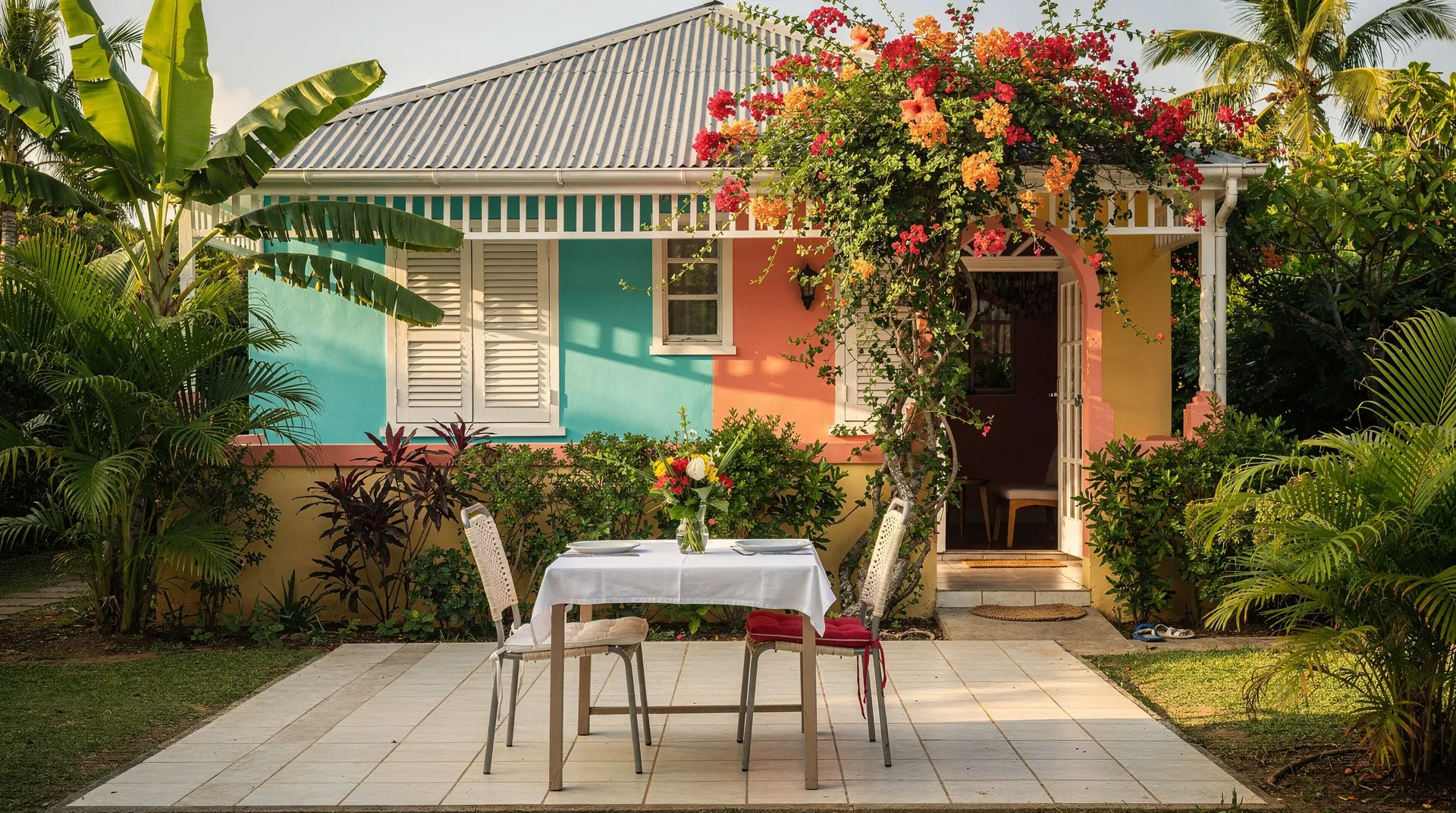
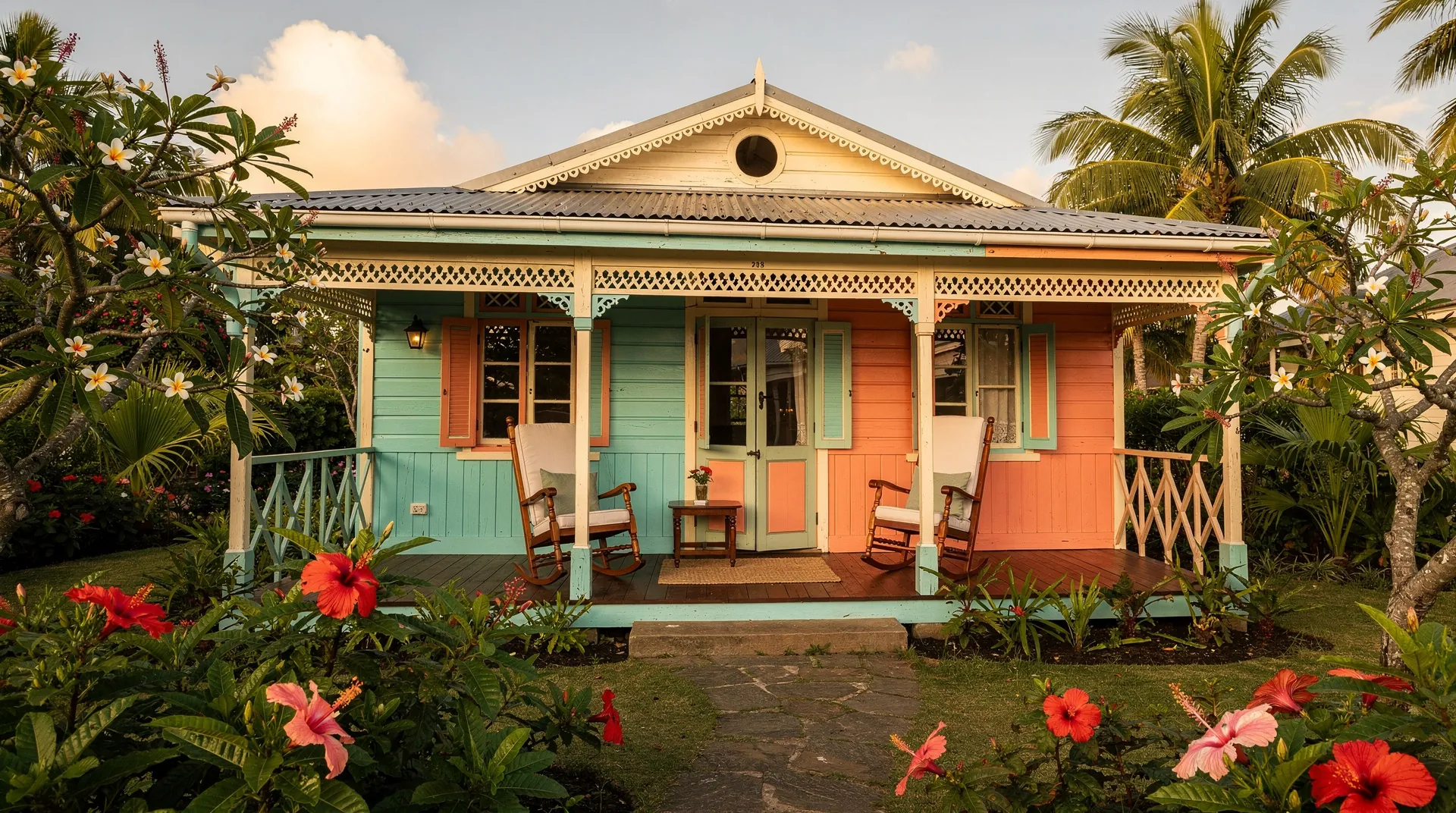
The self-contained cottage or bungalow is a small independent unit (studio or one-bedroom) located in the garden of a main house. You have your own entrance, your own privacy, and sometimes your own small kitchen. The owner is on site but you don’t share their living space. Many of these bungalows are listed on Airbnb.
What you can expect from a Mauritian guest house
Breakfast
The vast majority of guest houses include breakfast in the room rate. A good Mauritian breakfast includes seasonal tropical fruit (mango, papaya, pineapple, soursop depending on the season), various breads or roti, homemade jams, tea or coffee. In the good guest houses, it’s often the best meal of the day — and a chance to share conversation with the family.
The room
Rooms vary considerably. Some guest houses offer air-conditioned rooms with a private bathroom, tasteful decor and a garden view. Others are more basic: a fan, shared bathroom, functional decor. The price reflects these differences.
Always check whether the room is en-suite (private attached bathroom) or has a shared bathroom. For some travellers, this is a dealbreaker.
The services
Don’t expect hotel-level services: no room service, no minibar, no electronic safe, no 24-hour reception. In return, you’ll find hosts who are available, who know the island inside out and can recommend authentic local restaurants, lesser-known hikes, secret beaches and the best snorkelling spots.
This local knowledge is often more valuable than any travel guide.
The best areas for guest houses
Grand Baie and the north
The north has the highest density of guest houses in Mauritius. Most are located in Grand Baie, Pereybere, Cap Malheureux and Grand Gaube. The concentration of travellers in this area has given rise to a diverse offering, ranging from a simple room with a local family to a small, charming family-run hotel.
The advantage of the north: you’re a few minutes’ walk from the beach, restaurants and travel agencies. You can easily arrange catamaran trips, excursions to Ile aux Cerfs or swimming with dolphins outings directly from your guest house.
The downside: this is the most touristy part of the island, which can dilute the authenticity you’re looking for. Pereybere and Cap Malheureux have a more local feel than central Grand Baie.
Price: 40 to 90 EUR/night for a double room with breakfast.
Ideal for: solo travellers, couples on a discovery trip, backpackers, and anyone who wants the convenience of the north without hotel prices.
Mahebourg and the southeast
Mahebourg is arguably the best area for authentic guest houses on the island. This small port town is unassuming, affordable, and incredibly lively. Its Wednesday market is one of the finest on the island — and a real window into local life.
The guest houses here are often run by families of fishermen or shopkeepers who welcome guests with genuine warmth. Conversations over breakfast can be worth hours of museum visits when it comes to understanding the island’s history and culture.
What’s more, Pointe d’Esny and Blue Bay — just a few kilometres away — offer some of the island’s most beautiful beaches. The Blue Bay marine reserve offers free, outstanding snorkelling. It’s a perfect combination for a curious, independent traveller.
Price: 35 to 75 EUR/night for a double room.
Ideal for: authentic-experience seekers, budget travellers, anyone wanting to discover real Mauritian life, and those wanting to be close to the airport at the end of their stay.
Flic-en-Flac and the west coast
The west coast also has a handful of good guest houses, fewer than in the north but well located. Most are a few hundred metres from Flic-en-Flac’s long beach. The area is more residential than Grand Baie, which suits travellers looking for calm and the beach without the touristy bustle.
The sunsets seen from the terrace of a Flic-en-Flac guest house are among the most beautiful moments Mauritius has to offer.
Price: 45 to 90 EUR/night.
Ideal for: couples seeking authenticity, divers, and families wanting some peace and quiet.
Tamarin
Tamarin has a handful of guest houses in a pleasant residential setting. It’s the ideal starting point for early-morning dolphin-watching outings. The village has a very different feel from Grand Baie — more local, more laid-back, with several good neighbourhood restaurants.
Price: 50 to 100 EUR/night.
Rodrigues
For the most adventurous travellers, Rodrigues — the small sister island of Mauritius, reachable by plane or boat — is dotted with authentic guest houses. The Creole culture there is even better preserved, the scenery breathtaking, and the locals remarkably hospitable. Rodrigues guest houses often include local cuisine, which is an experience in itself.
Price: 50 to 100 EUR/night, all-inclusive.
How to find a good guest house in Mauritius
On Booking.com
Booking.com is the most widely used platform for Mauritian guest houses. Filter by “B&Bs and hostels” or “guest houses” to see the most relevant results. Reviews are verified and often very detailed — a valuable resource for gauging the real quality of a place before booking.
Advantage: clearly stated, often flexible cancellation policy. Downside: the platform’s commission fees are sometimes passed on to the displayed prices.
On Airbnb
Airbnb lists many guest houses and rooms with local families in Mauritius. Photos are generally numerous and representative. Reviews give a good sense of the welcome and comfort level. Independent garden bungalows attached to family homes are particularly well represented on this platform.
Direct booking
Some of the best Mauritian guest houses have little to no online presence. They rely on word of mouth or simply put a sign outside their house. If you’re travelling in a relaxed way, showing up in person can get you an even better price, especially in low season.
In travel guidebooks
Lonely Planet Mauritius and the Petit Futé feature guest houses vetted by their editorial teams. A little slower than online platforms to catch new places, but reliable for addresses established over several years.
What guest houses offer that hotels don’t
Human contact
This is unquestionably the number one argument. Guest house owners often have fascinating life stories, an intimate knowledge of their neighbourhood and a natural generosity towards their guests. Morning conversations over breakfast can be just as memorable as the most organised excursions.
Authentic local cooking
Some guest houses offer dinner on request. Never pass up this opportunity: home-cooked Mauritian food — rougaille, briani, fish daube, vegetable achard, octopus curry — is often far better than what you’ll find in tourist restaurants. It’s also a chance to pick up recipes to take home.
Local tips
Your host will point you to the best dholl puri stand in the neighbourhood, the secret beach tourists don’t know about, the best time to visit the market, the buses to take to get somewhere. This information is priceless. They’ll also tell you which car rental company is reliable for your car rental in Mauritius, and which taxi driver to call for the airport.
Supporting the local economy
By choosing a family-run guest house over a large international hotel chain, you ensure your money stays within the local Mauritian economy. It’s an ethical choice and often a more satisfying one — you know exactly who benefits from your stay.
What you need to accept when choosing a guest house
Less standardised comfort
The room might not be perfect: a slightly firm mattress, a squeaky tap, no hairdryer. If you need impeccable, predictable comfort, 4-5 star hotels are made for you. A guest house calls for adaptability and an open mind.
Fewer services
No night reception, no on-site restaurant (unless stated otherwise), no pool in most cases. Self-sufficiency is the rule. To offset this, apartment rental with a shared pool can be a good compromise if you want more independence.
The need for good communication
Arrival times, meals, special requests — everything goes through the owner. Clear, courteous communication is essential. Knowing a few words of Mauritian Creole or French (the island’s lingua franca) is greatly appreciated.
Variable quality
Unlike chain hotels, guest houses have no guaranteed standards. An 8/10 rating on Booking.com can mask significant differences between properties. Always read several recent reviews, look closely at the photos, and don’t hesitate to ask the owner precise questions before booking.
Comparison table: guest house vs apartment vs hotel
| Criteria | Guest house | Apartment | 3-4 star hotel |
|---|---|---|---|
| Price/night | 40-90 EUR | 60-180 EUR | 100-280 EUR |
| Human contact | Excellent | Moderate | Low |
| Meals included | Breakfast, often | No | Depends on plan |
| Pool | Rare | Often shared | Yes |
| Independence | Moderate | High | Low to moderate |
| Authenticity | High | Moderate | Low |
| Standardised comfort | Variable | Good | High |
Tips for a successful guest house stay
Contact the owner before you arrive. Introduce yourself, mention your habits (dietary requirements, usual wake-up time, expected arrival time), and ask your practical questions. An owner who responds quickly and warmly is generally a good sign.
Respect the house rules. Every guest house has its own habits: gate closing time, shared kitchen use, quiet hours at night. These rules are usually stated in the listing description or given on arrival.
Arrange your airport transfer in advance. Guest houses don’t have shuttles. A pre-booked taxi or private transfer is the best option, especially if you’re arriving late at night: book a private airport transfer in Mauritius.
Ask your host for activity recommendations. Guest house owners are often connected to the best hiking guides, kayak rental operators or local excursion agencies. Their recommendations are usually more reliable than those of an anonymous tourist agency.
Leave a detailed review after your stay. Family-run guest houses depend heavily on online reviews. A positive, detailed comment can genuinely make a difference to their business.
What you’ll learn by staying in a guest house
A stay in a Mauritian guest house is an open-air lesson in local culture. Here are a few things travellers report learning most often.
Everyday Creole culture
Mauritian society is an extraordinary melting pot — descendants of African slaves, Indian indentured labourers, French colonists, Chinese traders. This diversity lives on in the cuisine, the languages spoken, the music heard and the festivals celebrated. Your guest house host, whether Creole, Indo-Mauritian or Sino-Mauritian, will be a window onto this cultural richness that’s impossible to grasp from a big hotel room.
The Mauritian Creole language
Mauritian Creole (kreol morisien) is the island’s everyday language. A few basic phrases learned before you leave, or during your stay, will be much appreciated by your host: “Bonzour” (hello), “Mersi” (thank you), “Ki mannyer?” (how are you?). Most Mauritians also speak French and/or English.
Authentic recipes
If your host offers home-cooked dinners, it’s a chance to learn real Mauritian cooking — tomato rougaille, saffron-scented lamb briani, fish vindaye, vegetable achard. These recipes, handed down through generations, are among the best souvenirs you’ll bring back from the island. Our guide to Mauritian gastronomy tells you more about this exceptional cuisine.
Secret beaches and spots
Your guest house owner knows the quiet beaches, the hidden coves, the best snorkelling spots without the crowds. This information, found in no guidebook, is often the most valuable of all. A beautiful lagoon just a 10-minute walk from the guest house, reachable only via a path tourists don’t know about — that’s the kind of gift a guest house stay can offer.
Combining a guest house stay with activities: a rich trip without breaking the bank
Staying in a guest house doesn’t mean giving up on the iconic activities of Mauritius. With a reduced accommodation budget, you can put more money towards experiences.
Sample budget for a week for a couple in a guest house (excluding flights):
- Guest house in Pereybere (60 EUR/night x 7): 420 EUR
- Breakfast included, lunches from local markets and supermarkets: 150 EUR
- Dinners at local restaurants (dholl puri, curries, biryani): 200 EUR
- Full-day catamaran excursion (90 EUR x 2): 180 EUR — see catamaran outings to the northern islands
- Visit to Ile aux Cerfs (water taxi + entry): 100 EUR
- Car rental for 2 days (40 EUR x 2): 80 EUR
- Airport transfer (round trip): 70 EUR
- Miscellaneous (souvenirs, spontaneous activities): 150 EUR
Estimated total: 1,350 EUR for 2 people for 7 nights — compared to 3,000-4,000 EUR minimum for a 4-star hotel on half board with the same activities. The difference is significant.
Guest houses and sustainable development in Mauritius
By choosing a local guest house over an international hotel chain, you contribute directly to the Mauritian local economy. The money you spend stays in the hands of Mauritian families rather than flowing back to shareholders abroad.
What’s more, guest houses generally have a much smaller environmental footprint than large hotel complexes: less water consumption, less energy, less waste, no heated pools or permanent lighting of tropical gardens.
Several Mauritian guest house owners are also involved in local community initiatives — supporting local craftspeople for decor, buying fruit and vegetables from neighbourhood producers, and taking part in coral reef protection projects.
Guest house, apartment or small hotel: which suits your profile?
These three options often overlap in price but offer a different experience. A guest house suits you if human contact and local immersion matter more than independence. An apartment is preferable if you want to cook freely and manage your own schedule without interacting with a host. A small boutique hotel, usually 20 to 40% more expensive than an equivalent guest house, offers in exchange a reception desk, sometimes a pool, and more standardisation.
If you’re still torn between these options, our hotel versus villa comparison in Mauritius and our guide to where to stay in Mauritius detail the advantages of each option based on your travel style.
Safety and insurance in a guest house
Mauritian guest houses are generally safe, but they don’t always have an in-room safe. Keep your important documents and valuables on you, or ask your host if there’s a secure space available. As with any independent accommodation, checking your travel insurance before departure remains good practice, particularly for cancellation cover if you’re booking several months ahead.
The best guest houses for every type of traveller
For solo travellers: the guest houses of Pereybere and Mahebourg are ideal. A friendly atmosphere, easy to meet other travellers, and hosts available to guide you.
For couples: look for guest houses with an independent bungalow in the garden — you’ll have your privacy while still benefiting from the family’s advice and breakfast. Some offer a shared pool, a real bonus.
For families with children: guest houses with a kitchen available are particularly practical. Being able to prepare children’s meals as needed and keep their usual routine is a real advantage. Look for a guest house with a garden and, if possible, a pool.
For tight budgets: Mahebourg offers the best value addresses on the island. Clean rooms, a warm welcome, and the beautiful beaches of Blue Bay just a few kilometres away.