Visiting Mauritius without a car: a 7-day public transport itinerary
Visiting Mauritius without a car: it’s possible and enjoyable
Many travellers hesitate to rent a car in Mauritius, put off by driving on the left, the countless roundabouts, or simply because they don’t have a licence. The good news: it’s entirely possible to enjoy a wonderful week in Mauritius without ever getting behind the wheel.
This practical guide explains how to combine the various transport options available in Mauritius to visit its must-see sites, and lays out a full 7-day itinerary that can be done entirely without a rental car. If you’re on the fence about driving, our car rental guide for Mauritius honestly compares both options.
The key to a successful carless trip in Mauritius rests on two things: choosing the right base for your accommodation (to minimise day-to-day travel) and planning ahead for excursions to more distant sites. Our where to stay in Mauritius guide covers the best areas from this mobility angle.
At a glance
| Where to stay | Grand Baie or Trou aux Biches, to keep everything within walking distance |
| Transport budget | around 280 to 480 euros for two people over 7 days |
| Time needed | 7 full days, including 2 spent on organized day tours |
| How to get around | local buses, negotiated taxis, minibus tours from your hotel |
| Best time to visit | May to December, avoiding January-February (heat and cyclones) |
Getting around Mauritius without a car
Buses: cheap and authentic
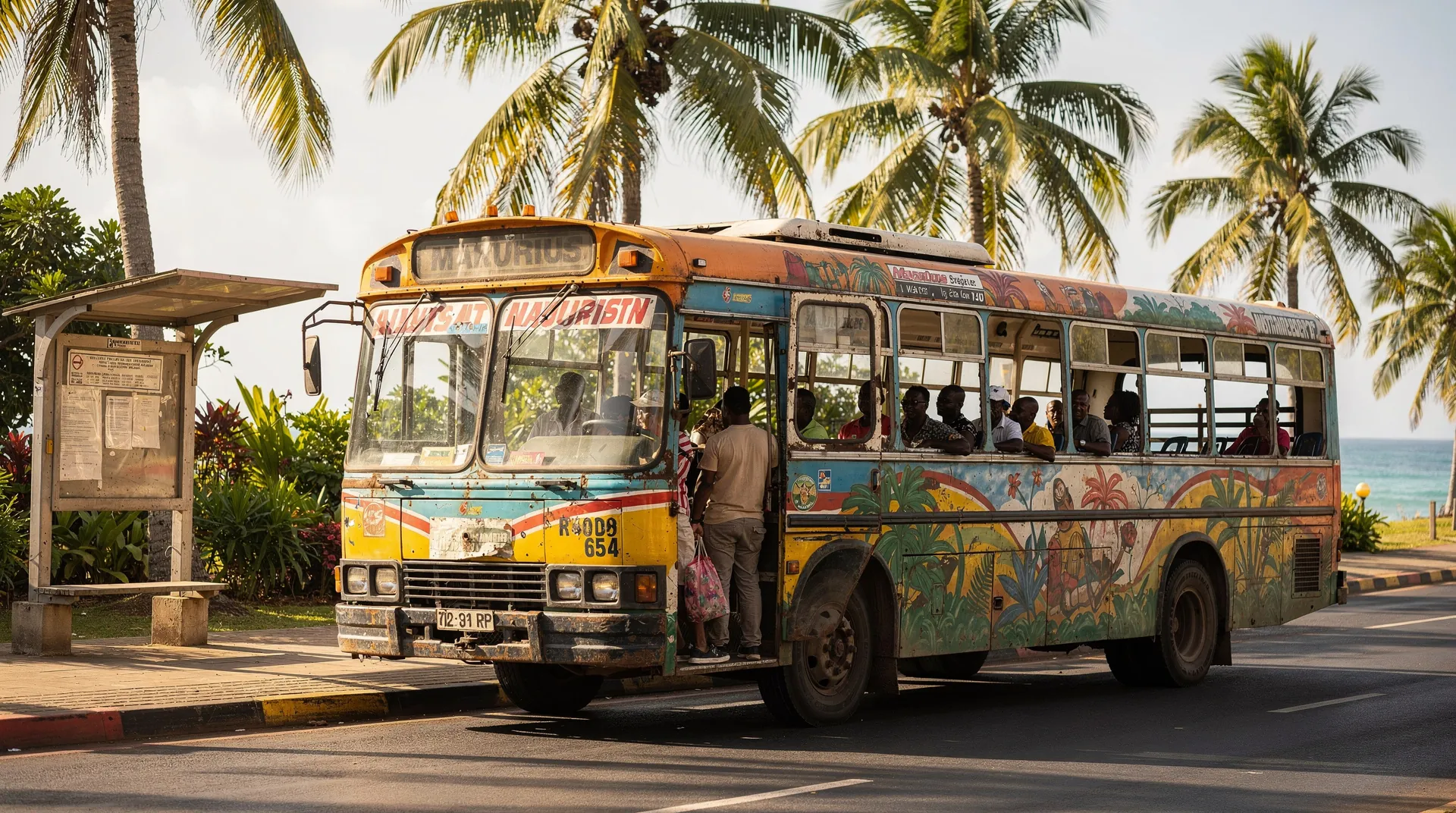
Mauritius has a bus network covering the whole island. Buses are run by several private companies (National Transport Corporation, Rose Hill Transport, Triolet Bus Service…) and connect all the main towns.
Pros: Very cheap (20-50 rupees per trip depending on distance), no booking needed, guaranteed local atmosphere. Taking the bus in Mauritius is an experience in itself — you travel alongside locals, listen to sega music, and watch local life go by through the window. It’s often where you get a taste of the real Mauritius.
Cons: Buses don’t reach everywhere. Some tourist sites (Chamarel, the national park, some secluded beaches like Bel Ombre) aren’t served. Schedules can be approximate. No buses at night.
Main bus routes:
- Port-Louis - Grand Baie (frequent line, every 15-20 min, 1h journey)
- Port-Louis - Mahébourg (via the motorway, 45 min)
- Port-Louis - Curepipe - Rose Hill (frequent, 30-45 min)
- Curepipe - Flic en Flac (roughly every hour)
Main terminus: The central terminus in Port-Louis is the hub of the whole network. From there, you can reach almost any town on the island.
Taxis: flexible but you have to negotiate
Mauritian taxis are plentiful and easy to find in tourist areas. They don’t have meters — the fare is negotiated before you set off. It’s a golden rule: always ask the price before getting in. Once you’re in the taxi, the price can’t be renegotiated.
Indicative prices:
- Grand Baie - Port-Louis: 500-700 rupees
- Port-Louis - Mahébourg: 800-1,200 rupees
- Grand Baie - Chamarel: 1,500-2,000 rupees
- Port-Louis - Flic en Flac: 700-1,000 rupees
These prices are for the whole taxi (not per person). Negotiate, especially for longer distances or if you keep the same taxi for several trips in a day.
Day taxis: Several taxi drivers offer day packages (generally 2,500-4,000 rupees for the day, depending on the itinerary). It’s an excellent option for more distant sites. You get a driver on hand all day who knows the island and can recommend the best local spots.
Finding a trustworthy taxi: Ask your host or guesthouse to recommend a driver. Once you find one you trust, keep their number — a good driver often becomes an unofficial guide, a mine of information about local life.
Ride-hailing apps and services
Uber isn’t available in Mauritius, but PickMeUp (the local equivalent) works in the main areas. The app lets you book a vehicle with the fare shown upfront. Available in Port-Louis, Grand Baie and the main tourist areas. More predictable than regular taxis for anyone who isn’t comfortable with negotiating.
Organized tours: the all-in-one solution
For must-see sites that are hard to reach without a car (Chamarel, Le Morne, the national park), organized tours from your hotel are the best solution. Most hotels or local agencies offer:
- South Circuit tour (Chamarel, Seven Coloured Earths, Le Morne): full day, 2,000-3,500 rupees/person. Our Chamarel guide helps you prepare for this excursion.
- Island tour: full day by minibus, all the major sites, 2,500-4,000 rupees/person
- Catamaran excursion (northern islands): a day at sea, 2,500-4,000 rupees/person
- Île aux Cerfs excursion: half-day or full day, 800-1,500 rupees/person
- Swimming with dolphins excursion at Tamarin: 3,000-5,000 rupees/person (transport from Grand Baie often included)
These tours have the advantage of including a guide, transport and sometimes meals. The downside is a lack of flexibility — you follow a group and a set schedule.
Hotel shuttles and transfers
Many hotels and resorts offer free shuttles to beaches, shopping centres or nearby tourist sites. Ask your accommodation on arrival about what’s included — some resorts offer daily transfers to Grand Baie or Port-Louis.
Airport-hotel transfers are easy to arrange in advance through your hotel or online agencies. Book ahead to avoid stress on arrival. A private airport-hotel transfer is the most comfortable and reliable option for a stress-free arrival, especially after an 11-hour flight.
Choosing the right base
For a carless trip, where you stay is crucial. Check out our where to stay in Mauritius guide for full details.
Grand Baie (north): The best choice for a carless trip. Grand Baie has restaurants, shops, beaches and tour agencies all within walking distance. The bus to Port-Louis runs regularly. Tour agencies are plentiful and competitive.
Port-Louis: Handy for visiting the capital and catching buses across the island, but not ideal for beaches (you’ll need to travel).
Flic en Flac (west): Great beach within walking distance, a handful of restaurants, but bus connections to the rest of the island are less frequent. Ideal if you’re mainly after beach relaxation with a few excursions.
Mahébourg (southeast): Charming and authentic, good bus connections to Blue Bay and Port-Louis, but limited access to southwest sites without a taxi or tour.
Trou aux Biches: Excellent beach, close to Grand Baie (15 min on foot or by bike), decent bus connections. A good alternative to Grand Baie for travellers seeking a bit more calm.
Not recommended without a car: Residential areas or isolated hotels in the South (Bel Ombre, remote stretches of the east coast) where amenities and transport are scarce. These areas are gorgeous but require a car to explore properly.
7-day carless itinerary
Day 1: arrival and settling in at Grand Baie
Arrange your airport transfer in advance through your hotel or an agency. Arrival is usually late afternoon or evening from Europe. Check in to your accommodation in Grand Baie.
Grand Baie can be fully explored on foot: beach, restaurants, bars, shops, everything is within reach without transport. A relaxed first evening at one of the many restaurants on the main street. A first Creole dinner at a local restaurant — dholl puri, rougail, carri — is the best possible start to discovering the island’s cuisine.
Day 2: Port-Louis by bus
Morning: Catch the bus from Grand Baie to Port-Louis (frequent departures from the central junction, 30-40 rupees). Terminus in the centre of Port-Louis.
A day on foot in the capital: the central market, Chinatown, Place d’Armes, Fort Adelaide. Lunch at the central market or one of Chinatown’s restaurants (a full meal for 200-400 rupees). Our guide to markets and culture gives you a map of the best spots to visit in the capital.
Afternoon: Caudan Waterfront and museums. Return by bus to Grand Baie in the late afternoon (last bus around 7-8pm, check local timetables).
Day 3: catamaran excursion — northern islands
Book the day before (or several days ahead in high season) a catamaran excursion from Grand Baie to Ile Plate and Ile Gabriel. The catamaran cruise to the northern islets from the Grand Baie marina is a spectacular day out, with transport from your hotel included if you’re staying in the Grand Baie area.
A day at sea: snorkelling over pristine coral reefs, a barbecue on a deserted beach, and a chance to spot dolphins in Tamarin bay. Back around 4pm in Grand Baie. This is often the favourite day for travellers doing this kind of carless trip.
Day 4: South Circuit excursion — Chamarel and Le Morne
Book a full-day minibus tour from Grand Baie. The classic South Circuit covers the island’s most spectacular sites, ones you couldn’t reach by bus.
The typical itinerary includes:
- Chamarel: Seven Coloured Earths, waterfall, coffee plantation — the southern excursion including Chamarel and Grand Bassin is a full package with transport included (our Chamarel guide prepares you for this visit)
- Le Morne Brabant: beach and UNESCO monument
- Lunch included in some packages (check when booking)
- Return around 5-6pm
Price: 2,000-3,500 rupees/person depending on the operator and services included.
Day 5: Île aux Cerfs
Catch the bus from Grand Baie to Port-Louis (30 min), then a second bus from Port-Louis to Trou d’Eau Douce (1h). Alternatively, arrange a shared taxi from your hotel (some hotels organize shuttles to Île aux Cerfs).
From Trou d’Eau Douce, the boat to Île aux Cerfs costs around 600 rupees return and departs regularly. Spend the morning and early afternoon on the island — white sand, turquoise water, water sports and lunch on site. Return by bus or taxi in the late afternoon.
Day 6: northern beaches on foot and by bike
Enjoy a relaxed day in the north. The beaches of Trou aux Biches and Mont Choisy are reachable on foot or by bike from Grand Baie (bike rental available, 200-400 rupees/day).
Cap Malheureux is about 7 km from Grand Baie — reachable by bike in 30-40 minutes along a flat coastal road. The view of the northern islands and the red church makes the ride worthwhile. It’s one of the most beautiful bike rides in Mauritius, suitable for all levels.
Free afternoon at the beach in Grand Baie or Pereybere (on foot). Snorkelling options from these beaches are plentiful and don’t require a boat.
Day 7: Pamplemousses and freedom
Morning: Catch the bus from Grand Baie to Port-Louis, then a connecting bus to Pamplemousses (or a direct taxi for 400-600 rupees). Visit the Botanical Garden (2 hours). The giant water lilies, centuries-old palm trees and free-roaming giant tortoises make for a memorable and accessible natural spectacle.
Afternoon: Back to Grand Baie. Last-minute shopping (crafts, spices, rum), beach time, and packing.
If your flight is in the evening, a taxi from Grand Baie to the airport costs around 1,000-1,500 rupees. Book it the day before to be sure of having a driver available at the right time. For extra peace of mind, our airport transfer guide covers all the options.
Transport budget for 7 days without a car
Estimate for two people:
- Airport transfers (there and back): 600-1,200 rupees
- Daily buses (6 days x 2 trips x 2 people): 480-960 rupees
- Occasional taxis (4-5 trips): 2,000-4,000 rupees
- Catamaran excursion (2 people): 5,000-8,000 rupees
- South Circuit excursion (2 people): 4,000-7,000 rupees
- Île aux Cerfs boat (2 people): 1,200 rupees
- Bike rental (1 day x 2 people): 400-800 rupees
- Estimated total transport: 13,680 to 23,160 rupees (roughly 280 to 480 euros)
By comparison, a rental car for 7 days (35 euros/day) plus petrol comes to around 270-320 euros. The costs are therefore similar, but flexibility is far greater with a car. Our Mauritius budget guide helps you compare both options in detail.
Adding carless experiences
Swimming with dolphins: Organized excursion from Grand Baie or from Tamarin by taxi. Operators arrange transport from the main tourist areas. A memorable experience you can enjoy without a car.
Whale watching (July-November): Organized boat trips from Tamarin. Transport from Grand Baie included in some packages. The humpback whales that pass off the coast of Mauritius are a spectacular sight.
Spa and wellness: The large hotels in Grand Baie or Trou aux Biches offer day treatments even for non-guests. Reachable on foot from your accommodation if well located.
Snorkelling and diving: Directly from the beaches of Grand Baie, Trou aux Biches or from catamaran excursions. No car needed.
What you can’t (or can barely) do without a car
Let’s be honest: some experiences are hard to have without a car in Mauritius.
The isolated sites of the South: Gris-Gris, the wild coastline between Souillac and Le Morne, Bel Ombre — these areas aren’t served by any public transport and taxis there are rare and expensive. An organized tour remains the only realistic alternative.
Spontaneous exploration: One of the joys of a Mauritius road trip is stopping on a whim to photograph a sugar cane field, taking an unfamiliar coastal road, or pulling into an unknown village. Without a car, that spontaneity is limited.
The Black River Gorges National Park: Reachable by taxi, but getting back without a car from deep inside the park is complicated. Organized tours are really the best option here for hiking in this exceptional site.
Flexible timing: With buses and tours, you depend on other people’s departure and arrival times. With a car, you leave when you want and get back when you please.
Apps and tools for stress-free travel
A well-equipped phone partly replaces the freedom a car gives you. As soon as you arrive at SSR airport, get a local SIM card: without data, negotiating a taxi or finding a bus stop becomes far more uncertain. Our guide to useful apps for travelling in Mauritius covers the tools to install before you leave — offline maps, a local ride-hailing app, weather tracking to adjust your boat excursions.
Always keep a rough journey time estimate in mind before negotiating a taxi: our guide to travel times between the island’s areas helps you avoid overpaying for what’s actually a short trip, or accepting an unreasonable fare for lack of a reference point.
Quick comparison: without a car or with a rental car
| Criteria | Without a car | With a rental car |
|---|---|---|
| Transport budget (7 days, 2 people) | 280-480 € (bus, taxis, tours) | around 270-320 € (rental + fuel) |
| Schedule flexibility | Low, depends on buses and tours | Total, leave whenever you want |
| Access to isolated sites (Bel Ombre, Gris-Gris) | Only via organized tour | Direct |
| Contact with local life | Strong (bus, markets, drivers) | Variable, depends on stops chosen |
| Logistical stress | Bookings to plan every day | Left-hand driving to master |
| Ideal for | First trip, travellers without a licence | Road trip, in-depth exploration |
To dig deeper into this question, our detailed with-or-without-a-car comparison covers every cost item and practical constraint.
Safety and common sense when travelling without a car
Travelling by bus and taxi in Mauritius is generally safe, but a few habits will help you avoid unpleasant surprises. Never get into an unidentified vehicle whose driver approaches you insistently near a tourist site — stick to officially parked taxis or ones recommended by your accommodation. At night, always favour a taxi booked in advance rather than waiting on the street, since buses stop running after dark. Our safety in Mauritius guide covers general precautions to know, whether or not you have a car.
Finally, always keep a small reserve of cash in rupees on you: few bus or taxi drivers accept card payments, and getting stuck without cash at the end of the day is one of the most common annoyances for carless travellers.
This carless guide works perfectly for a first trip or for travellers who’d rather hand off the logistics. For those who want to explore Mauritius in depth and at their own pace, our classic 7-day car itinerary remains the most recommended option.